
Total 126 Questions
Last Updated On : 18-Oct-2026
Preparing with Salesforce-Platform-Foundations practice test 2026 is essential to ensure success on the exam. It allows you to familiarize yourself with the Salesforce-Platform-Foundations exam questions format and identify your strengths and weaknesses. By practicing thoroughly, you can maximize your chances of passing the Salesforce certification 2026 exam on your first attempt. Start with free Salesforce Certified Platform Foundations sample questions or use the timed simulator for full exam practice. Surveys from different platforms and user-reported pass rates suggest Salesforce Certified Platform Foundations practice exam users are ~30-40% more likely to pass.

An insurance call center is experiencing increased policy support callswhich hasled to long wait times and disappointed customers.
Which cloud will decrease the number of incoming calls, empower customers, and increase satisfaction?
A. CRM Analytics
B. Experience
C. Cloud Sales Cloud
Explanation:
🧠 Why This Is Correct
Salesforce Experience Cloud (formerly Community Cloud) enables organizations to build self-service portals, customer communities, and support forums that empower customers to:
Find answers on their own via knowledge articles, FAQs, and peer discussions
Submit and track support cases
Access policy details, claims, and account information
This reduces the volume of incoming calls and improves customer satisfaction by offering 24/7 access to support resources.
📘 References:
What Is Experience Cloud? – Salesforce Help
Empower Customer Engagement with Experience Cloud
❌ Why the Other Choices Are Wrong
A. CRM Analytics
CRM Analytics provides insights and dashboards for supervisors and managers. It helps analyze call center performance but does not directly reduce call volume or empower customers.
C. Sales Cloud
Sales Cloud is focused on sales processes, lead management, and opportunity tracking. It’s not designed for customer self-service or support call reduction.
🎯 Exam Tip
This question tests your understanding of Salesforce product fit for service scenarios.
Use Experience Cloud for customer empowerment and case deflection
Use CRM Analytics for internal performance insights
Use Sales Cloud for sales automation
Get Cloudy Consulting requires a value in the Status field every time a record is created or edited. What should they do to enforce this?
A. Make the field required in Object Manager.
B. Make the field required with a validation rule.
C. Make the field required in organization-wide defaults.
Explanation:
Option A (Correct) – In Object Manager, you can set a field as required, which forces users to enter a value before saving a record (both on creation and edits). This is the simplest and most direct way to enforce a mandatory field.
Option B (Incorrect) – A validation rule could technically enforce this, but it’s unnecessary for basic field requirements. Validation rules are better for complex logic (e.g., "Status must be 'Closed' if the Opportunity Amount is > $10,000").
Option C (Incorrect) – Organization-Wide Defaults (OWD) control record-sharing visibility, not field requirements. This option is irrelevant to the question.
Reference:
Salesforce Help - Make a Field Required
Get Cloudy Consulting (GCC) provides consulting servicesto smalland medium-sized business in the financial services space. GCC wants a solution for customer service where complaints can be logged through a web from and email.
Which Salesforce solution should GCC use?
A. Commerce Cloud
B. Experience Cloud
C. Service cloud
Explanation:
Service Cloud is the ideal Salesforce solution for this scenario because it is specifically designed for customer service and support operations. The core function of Service Cloud is to manage customer inquiries, issues, and complaints, which are known as cases in Salesforce. The ability to log complaints through a web form and email are standard, out-of-the-box features of Service Cloud.
Detail:
Core Concept: The question tests your understanding of the different Salesforce Clouds and their primary use cases. This is a fundamental concept for the Platform Foundations exam. You need to be able to match a business need (customer service) with the correct Salesforce product.
How it Works in Salesforce:
Web-to-Case: This feature allows an administrator to generate an HTML form that can be embedded on a company's website. When a customer fills out and submits this form, it automatically creates a new case record in Salesforce. This is how the "complaints logged through a web form" requirement is met.
Email-to-Case: This feature automatically creates a new case record from an email sent to a designated company support address (e.g., support@getcloudyconsulting.com). The body of the email becomes the case description, and the sender is associated with a contact or lead. This satisfies the "complaints logged through...email" requirement.
Exceptions/Limitations: While Web-to-Case and Email-to-Case are powerful, they have limitations. For example, there's a daily limit on the number of cases that can be created via these methods.
Incorrect Answers
A. Commerce Cloud
Why it's wrong: Commerce Cloud is designed for e-commerce. It helps businesses create online stores, manage product catalogs, process orders, and handle the entire digital shopping experience. While customer service is a part of the commerce lifecycle, Commerce Cloud itself doesn't provide the core case management tools needed to track and resolve complaints in a structured way.
B. Experience Cloud
Why it's wrong: Experience Cloud (formerly Community Cloud) is used to create branded digital experiences, such as customer portals and partner communities. You could certainly build a customer portal with a web form for complaints using Experience Cloud. However, the underlying functionality that processes these complaints and turns them into trackable cases is still a feature of Service Cloud. Experience Cloud is the front-end portal, while Service Cloud is the back-end system for managing the cases created from that portal. Service Cloud is the more direct and comprehensive solution for the business problem.
Reference:
Trailhead Module: Service Cloud for the Salesforce Administrator
Salesforce Help: Web-to-Case and Email-to-Case
Real-World Scenario
Get Cloudy Consulting wants to streamline its customer complaint process. Instead of having customer service reps manually create a new case every time a client sends an email or fills out a contact form, they can use Service Cloud. The admin sets up Email-to-Case so that any email to support@getcloudyconsulting.com automatically creates a new case and assigns it to a support queue. The admin also creates a Web-to-Case form, embeds it on their website's "Contact Us" page, and configures it to automatically create cases for new complaints. This ensures that all complaints are logged consistently, routed correctly, and tracked efficiently until they are resolved.
Get Cloudy Consulting (GCC) wants to customize its Sales application’s Home tab with additional components. Outside of the org, where should GCC' Salesforce associate go to collaborate with others on solutions that might resonate with GCC users?
A. Explore documents In Help and Training.
B. Ask a question In a Trailblazer Community Group.
C. Search for modules in Trailhead.
Explanation:
When Get Cloudy Consulting (GCC) wants to collaborate with others outside of their org to find solutions that resonate with users, the Trailblazer Community is the ideal place. It’s a vibrant forum where Salesforce professionals, admins, developers, and consultants share ideas, ask questions, and offer solutions based on real-world experience.
Trailblazer Community Groups are organized by role, product, region, and interest.
GCC’s associate can post questions, join discussions, and even attend virtual or in-person meetups.
This is especially useful for customization ideas, best practices, and peer feedback.
📚 Why Not the Other Options?
A. Help and Training
Good for official documentation, but not collaborative. It’s more of a reference than a discussion space.
C. Trailhead Modules
Excellent for learning, but not interactive. You can’t ask questions or get feedback from others.
📎 Reference:
Trailblazer Community Overview – Salesforce Help
Join a Trailblazer Group – Trailblazer Community
A Salesforce Associate is asked to review multiple reports from the current month's folder and bring insight into a meeting. How should the associate locate all the reports in a single location from the Report object?
A. Use the Global search bar
B. Click on All Reports and use the search bar
C. Click on All Folders and use the search bar
Explanation:
Option C (Correct)
– Since the reports are stored in a specific folder (the "current month's folder"), the best way to locate them is by navigating to All Folders, selecting the relevant folder, and then using the search bar if needed. This ensures all reports in that folder are grouped together.
Option A (Incorrect)
– The Global Search bar can find reports, but it searches across all records in Salesforce, not just the reports in the desired folder. This makes it inefficient for locating reports in a specific folder.
Option B (Incorrect)
– All Reports shows every report in the org, not just those in a particular folder. While you could filter manually, it’s less efficient than going directly to the folder.
Reference:
Salesforce Help - Find and View Reports
Refer to the screenshot that shows the top portion of the Salesforce Service app with areas labeled A, B, and C.
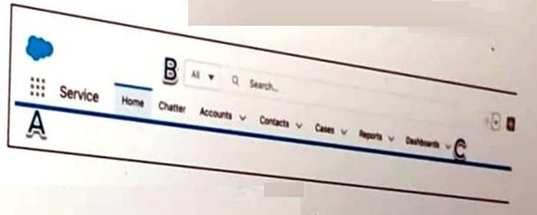
Get Cloudy Consulting (GCC) offers sales and services consoles to meet the various needs of its end users?
Where should GCC' end users go to change to the Sales Console.
A. App Launcher icon (Label A)
B. Search bar (Label b)
C. A dropdown in the navigation bar (Label C)
Explanation:
Why this is correct
The App Launcher (labeled A in the screenshot) is the grid icon in Salesforce Lightning Experience that lets users switch between different apps, such as the Service Console and Sales Console.
For GCC’s scenario:
End users currently in the Service Console can click the App Launcher.
They can then search for or select Sales Console to switch apps.
This is the standard method for navigating to a different console app in Salesforce.
📖 Salesforce Documentation:
“Use the App Launcher to switch between apps and find the items and data you need.”
Salesforce Help: App Launcher
Why the other options are incorrect
B. Search bar (Label B) ❌
The search bar is for finding records, objects, and other resources within Salesforce, not for switching between apps.
C. A dropdown in the navigation bar (Label C) ❌
The navigation bar dropdown customizes tabs within the current app but does not change to a different app, like the Sales Console.
Salesforce associate received a promotion and needs Edit access to fields on opportunity records across the organization. Which user setting need updating to allow Edit access?
A. Queue
B. Permission Set
C. Public Group
Explanation:
In Salesforce, field-level permissions and record-level access are controlled through a combination of profiles and permission sets.
If a Salesforce associate needs Edit access to specific fields (or entire records) across the organization, an administrator can:
Update the user’s profile, or
Assign a permission set that grants the needed “Edit” permissions for the Opportunity object or its fields.
Permission sets are preferred when you want to grant additional permissions without changing the user’s base profile.
Key point:
This is about user settings for access rights, not record ownership or grouping.
Why not the other options?
A. Queue ❌
Queues are for managing ownership of records (e.g., unassigned leads or cases), not for granting editing permissions.
C. Public Group ❌
Public Groups are used for sharing rules and collaboration (e.g., in Chatter or folder access), but they don’t inherently give field-level “Edit” permissions.
Reference:
Salesforce Help: Permission Sets Overview– See how to extend user access without modifying profiles.
Get Cloudy Consulting currently stores information about is customers and partners in the Account object. There are a few details specific to partners that are not applicable to customers. What is the recommended way to display only the information application to each group?
A. Use Account for customers and create a custom object for partners.
B. Create record types on Account called Partner and Customer
C. Create custom object called Partner and Customer
Explanation:
Option B (Correct) – Record types allow you to segment data within the same object while displaying different fields, page layouts, and picklist values based on the record type. Since both customers and partners are logically stored in the Account object, using record types is the most efficient and scalable solution.
Benefits:
Avoids data duplication (unlike creating a custom object).
Maintains reporting consistency (all accounts remain in one object).
Allows for different page layouts and business processes for each type.
Option A (Incorrect) – Creating a custom object for partners would unnecessarily complicate data management. Since partners are still accounts (just with different attributes), splitting them into a separate object would:
Break standard Salesforce relationships (Contacts, Opportunities).
Require extra reporting and integration work.
Option C (Incorrect) – Similar to Option A, this suggests creating two separate custom objects, which is redundant and inefficient. The Account object already supports this use case via record types.
Reference:
Salesforce Help - Record Types
Get Cloudy Consulting (GCC) has recently been onboarded as aSalesforce customer. GCC wants to enroll its in-house IT administration team in a Salesforce instructor-led training workshop. Which resource provides virtual and in-person learning that should help the team accelerate their Salesforce knowledge?
A. Trailhead Community
B. Salesforce Help
C. Trailhead Academy
Explanation:
Get Cloudy Consulting (GCC) is looking to enroll its in-house IT administration team in a Salesforce instructor-led training workshop that offers both virtual and in-person learning to accelerate their Salesforce knowledge. Among the provided options, Trailhead Academy is the resource that best fits this requirement, as it provides expert-led, instructor-driven training sessions in both virtual and in-person formats, tailored to build and validate Salesforce skills.
Option A: Trailhead Community
The Trailhead Community is a collaborative platform where Salesforce users, including admins, developers, and other professionals, can connect, ask questions, share knowledge, and collaborate with peers. While it’s valuable for peer-to-peer learning and networking, it does not offer structured, instructor-led training workshops, either virtually or in-person.
Why this is incorrect: The Trailhead Community focuses on community-driven support and discussions, not formal instructor-led training, which doesn’t meet GCC’s need for a structured workshop.
Option B: Salesforce Help
Salesforce Help is the official documentation portal that provides detailed guides, articles, and resources on Salesforce features, configurations, and troubleshooting. It’s an excellent self-service resource for learning, but it does not offer instructor-led training workshops, whether virtual or in-person.
Why this is incorrect: Salesforce Help is a self-paced resource and does not provide the interactive, expert-led training experience GCC is seeking.
Option C: Trailhead Academy
Trailhead Academy is Salesforce’s official training program that offers instructor-led classes, both virtual and in-person, delivered by certified Salesforce experts. These workshops cover a wide range of topics, including Salesforce administration, and are designed to accelerate learning for teams and individuals. Courses like ADX201 (Essentials for New Lightning Experience Administrators) are specifically tailored for IT administration teams to build foundational and advanced Salesforce skills.
Why this is correct: Trailhead Academy directly addresses GCC’s need for instructor-led training workshops available in both virtual and in-person formats, making it the ideal resource to help the IT administration team accelerate their Salesforce knowledge.
Reference:
Salesforce Trailhead Academy: Trailhead Academy Overview – Describes Trailhead Academy as offering virtual and in-person instructor-led classes to build Salesforce expertise.
Salesforce Help Documentation: Trailhead Academy for Admins – Highlights how Trailhead Academy provides structured training for Salesforce administrators.
Trailhead Module: Salesforce Fundamentals – Introduces learning paths, including Trailhead Academy for expert-led training.
The Health Department wants to gain more insight into its patient data than what
SalesforceDashboards canprovide.
Which Salesforce product should the department use?
A. Experience Cloud
B. CRM Analytics
C. Health Cloud
Explanation:
CRM Analytics (formerly Tableau CRM) is designed for advanced data analysis, allowing users to uncover deep insights using AI-driven dashboards, predictive analytics, and interactive visualizations beyond standard Salesforce reports and dashboards.
The Health Department needs more powerful analytics than standard dashboards, making CRM Analytics the best choice.
Why Not the Other Options?
A) Experience Cloud – Incorrect, because this is for building customer portals (not advanced analytics).
C) Health Cloud – Incorrect, as it is an industry-specific CRM for patient management, but does not provide the advanced analytics capabilities of CRM Analytics.
Reference:
CRM Analytics Overview
| Page 1 out of 13 Pages |
| 1234 |
Our new timed 2026 Salesforce-Platform-Foundations practice test mirrors the exact format, number of questions, and time limit of the official exam.
The #1 challenge isn't just knowing the material; it's managing the clock. Our new simulation builds your speed and stamina.
You've studied the concepts. You've learned the material. But are you truly prepared for the pressure of the real Salesforce Certified Platform Foundations exam?
We've launched a brand-new, timed Salesforce-Platform-Foundations practice exam that perfectly mirrors the official exam:
✅ Same Number of Questions
✅ Same Time Limit
✅ Same Exam Feel
✅ Unique Exam Every Time
This isn't just another Salesforce-Platform-Foundations practice questions bank. It's your ultimate preparation engine.
Enroll now and gain the unbeatable advantage of:
| Feature | Salesforceexams.com | Generic Study Platforms |
|---|---|---|
| Realistic Practice Test Format | Matches actual Plat-101 exam structure and difficulty | Often too simple or outdated |
| Detailed Explanations | Every answer includes clear, easy-to-understand reasoning | Limited or no explanations |
| Topic-Wise Coverage | Covers all domains: Navigation, Data, Reports, CRM | May skip essential Associate-level topics |
| Performance Tracking | Identifies strengths and weaknesses automatically | Little to no performance feedback |
| Updated Questions | Regularly updated to reflect latest exam changes | Static and sometimes outdated content |
| First-Time Pass Support | Designed to maximize your chances on the first try | No guarantee of readiness |

Copyright © - All Rights Reserved