
Question 1
Choose 1
A large business-to-consumer (B2C) customer is planning to implement Salesforce CRM to
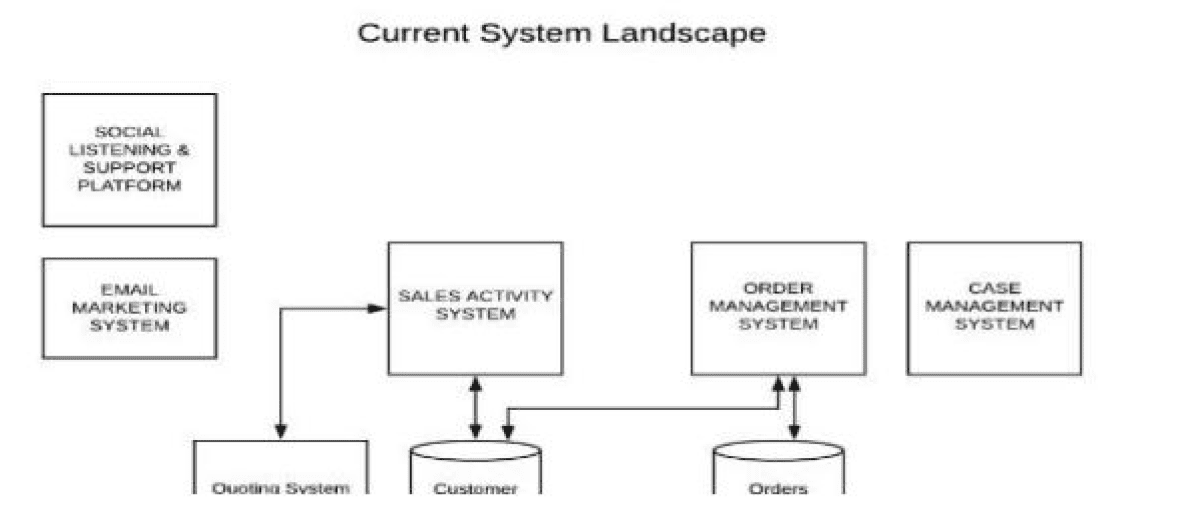
become a customer-centric enterprise. Below is the B2C customer's current system
landscape diagram.
The goals for implementing Salesforce include:
Develop a 360-degree view of the customer.
Leverage Salesforce capabilities for marketing, sales, and service processes.
Reuse Enterprise capabilities built for quoting and order management processes.
Which three systems from the current system landscape can be retired with the implementation of Salesforce?
Correct answer:
C. Email Marketing, Sales Activity, and Case Management
Explanation:
The key to this question is matching the stated goals against which systems Salesforce natively replaces versus which systems must be reused and integrated with based on the explicit requirement.
The goals state:
Develop a 360-degree view of the customer
This is achieved by consolidating customer data into Salesforce.
Leverage Salesforce capabilities for marketing, sales, and service processes
This directly signals that Salesforce, through Marketing Cloud or Pardot capabilities, Sales Cloud, and Service Cloud, will replace the systems handling marketing, sales, and service or case functions.
Reuse enterprise capabilities built for quoting and order management processes
This explicitly states that the Quoting System and Order Management System should be kept and integrated with rather than replaced, because the company wants to leverage its existing enterprise investments in these capabilities.
Mapping this to the diagram:
Email Marketing System → replaced by Salesforce marketing capabilities → retire
Sales Activity System → replaced by Salesforce Sales Cloud → retire
Case Management System → replaced by Salesforce Service Cloud → retire
Social Listening & Support Platform → not explicitly called out in the goals; typically retained and integrated as a specialized tool rather than replaced by a core CRM function identified in the requirements.
Quoting System → explicitly called out to be reused, not retired
Order Management System → explicitly called out to be reused, not retired
Why not the others:
A. Order Management, Case Management, Email Marketing — Incorrect
Order Management is explicitly called out in the goals as a system whose capabilities should be reused and integrated, not retired.
B. Sales Activity, Order Management, Case Management — Incorrect
This has the same issue. Order Management should be retained according to the stated goal of reusing existing enterprise quoting and order management capabilities.
Key Exam Takeaway
When a scenario provides explicit business and architecture goals, map each system in the landscape diagram against those goals rather than assuming Salesforce will replace every existing system.
Here, the goals explicitly identify Quoting and Order Management as capabilities to integrate with and reuse, not decommission. This reflects a common enterprise architecture pattern in which Salesforce serves as the customer engagement and CRM layer while existing backend systems of record remain in place.
Reference
Salesforce Integration Patterns and Practices — Enterprise Architecture Considerations, including the CRM system-of-engagement model and integration with backend systems of record.