
Total 124 Questions
Last Updated On : 18-Oct-2026
Preparing with Salesforce-Platform-Integration-Architect practice test 2026 is essential to ensure success on the exam. It allows you to familiarize yourself with the Salesforce-Platform-Integration-Architect exam questions format and identify your strengths and weaknesses. By practicing thoroughly, you can maximize your chances of passing the Salesforce certification 2026 exam on your first attempt. Start with free Salesforce Certified Platform Integration Architect (SP25) sample questions or use the timed simulator for full exam practice. Surveys from different platforms and user-reported pass rates suggest Salesforce Certified Platform Integration Architect (SP25) practice exam users are ~30-40% more likely to pass.

Northern Trail Outfitters (NTO) has an affiliate company that would like immediate notifications of changes to opportunities in the NTO Salesforce instance. The affiliate company has a CometD client available. Which solution is recommended in order to meet the requirement?
A. Implement a polling mechanism in the client that calls the SOAP API getUpdated method to get the ID values of each updated record
B. Create a PushTopic update event on the Opportunity object to allow the subscriber to react to the streaming API
C. Create a connected app in the affiliate org and select “Accept CometD API Requests
Explanation:
B. Create a PushTopic update event on the Opportunity object:
Correct. The requirement is for the affiliate company to receive immediate or near-real-time notifications when Opportunities change in the NTO Salesforce org. Since the affiliate already has a CometD client, Salesforce Streaming API is the appropriate integration mechanism.
A PushTopic defines a Streaming API channel based on a SOQL query. When an Opportunity record matches the PushTopic criteria and is updated, Salesforce generates a notification that the external CometD client can receive.
Streaming API uses CometD and the Bayeux protocol, allowing external clients to subscribe to Salesforce event channels and receive notifications without repeatedly polling Salesforce.
For example, the PushTopic could be configured around an Opportunity query such as:
SELECT Id, Name, StageName, Amount
FROM Opportunity
The affiliate's CometD client would then subscribe to the corresponding /topic/... channel and process the notifications.
Why the other options are incorrect
A. Poll the SOAP API getUpdated method:
Incorrect. getUpdated() follows a polling approach. The affiliate client would have to repeatedly call Salesforce to determine whether records have changed.
That does not satisfy the requirement as effectively as a push-based Streaming API solution. Salesforce describes Streaming API as a way to reduce unnecessary API requests associated with constant polling and to provide near-real-time notifications.
C. Create a connected app in the affiliate org and select "Accept CometD API Requests":
Incorrect. The CometD client needs to connect to the NTO Salesforce org because that is where the Opportunity records and event source reside. Creating a connected app in the affiliate org does not create a mechanism for NTO Opportunity changes to be published to the affiliate.
The key requirement is to configure the event source in NTO and have the external CometD client subscribe to it.
Exam takeaway
When you see:
External system or client
Immediate or near-real-time Salesforce record-change notifications
CometD client
Salesforce record such as Opportunity
Think Streaming API + PushTopic for this legacy exam scenario. Salesforce now classifies PushTopic as a legacy technology and recommends Change Data Capture for newer implementations, but B is the expected answer among these choices.
What is the first thing an integration architect should validate if a callout from a Lightning web component to an external endpoint is failing?
A. The endpoint URL has been added to Content Security Policies
B. The endpoint domain has been added to Cross-Origin Resource Sharing.
C. The endpoint URL has been added to Remote Site Settings
Explanation:
Why A is correct:
Lightning Web Components (LWCs) execute client-side code directly inside the user's browser. By default, Salesforce enforces a strict Content Security Policy (CSP) to help prevent cross-site scripting (XSS) and code injection attacks. This policy blocks outbound client-side HTTP or Fetch requests and WebSocket connections to third-party endpoints unless the target domain is explicitly registered under CSP Trusted Sites, also known as Trusted URLs, in Salesforce Setup with the appropriate directives enabled, such as connect-src.
Why B is incorrect:
Cross-Origin Resource Sharing (CORS) is a browser-level security mechanism enforced by the external server receiving the request. It determines whether that server allows responses to be read by a different origin, such as Salesforce. While CORS configuration issues can cause callouts to fail, configuring CORS within Salesforce whitelist settings is used for incoming requests to Salesforce APIs from external applications, not for outbound requests originating from an LWC.
Why C is incorrect:
Remote Site Settings are required for server-side callouts originating from Apex, such as requests made using the Http class. They do not govern client-side JavaScript or Lightning Web Component execution.
Reference/;
Salesforce Pattern: Client-Side Integration Security / Lightning Security Architecture
Salesforce Documentation: Call APIs from JavaScript (LWC Developer Guide)
Northern Trail Outfitters (NTO) wants to improve the quality of callouts from Salesforce to its REST APIs. For this purpose, NTO will require all API Clients/consumers to adhere to REST API Markup Language (RAML) specifications that include the field-level definition of every API request and response Payload. The RAML specs serve as interface contracts that Apex REST API Clients can rely on. Which design specification should the integration architect include in the integration architecture to ensure that Apex REST API Clients’ unit tests confirm Adherence to the RAML specs?
A. Require the Apex REST API Clients to implement the HttpCalloutMock
B. Call the HttpCalloutMock Implementation from the Apex REST API Clients
C. Implement HttpCalloutMock to return responses per RAML specification
Explanation:
Apex requires unit tests for callout logic, and Salesforce does not allow real HTTP callouts during test execution. Developers must use the HttpCalloutMock interface to simulate the external endpoint's response. The key requirement here is that the unit tests must confirm adherence to the RAML specification, meaning the mock responses need to be built directly from the field-level request and response payload definitions in the RAML contract.
By implementing HttpCalloutMock so that it returns responses that precisely match the structure, fields, and data types defined in the RAML specification, the architect ensures that:
The Apex client code is tested against a realistic, contract-accurate response.
Any mismatch between what the Apex code expects and what the actual API contract defines, such as missing fields, incorrect data types, or unexpected null values, will surface as test failures.
The tests validate actual adherence to the interface contract, rather than simply confirming that a callout occurred without throwing an exception.
This makes the mock the actual mechanism for validating conformance to the RAML specification. It is not enough to simply use a mock or invoke it; the mock's content must be driven by the specification for the tests to provide meaningful contract validation.
Why not the others:
A. Require Clients to implement HttpCalloutMock:
This only states that mocking must be used. It is a necessary but insufficient design specification because it says nothing about validating adherence to the RAML contract itself. Any mock implementation, including one returning arbitrary or incorrect data, would satisfy this requirement, defeating the purpose of the validation.
B. Call the HttpCalloutMock implementation from the clients:
This describes basic test setup mechanics, such as using Test.setMock() to inject the mock, but it does not address the actual goal of confirming that payloads conform to RAML. Implementing and invoking a mock without RAML-based content does not prove specification adherence.
Key exam takeaway
The differentiator is what the mock returns, not simply that a mock exists or is invoked. To validate a contract, test doubles should be built from that contract.
Reference
Apex Developer Guide - Testing HTTP Callouts (HttpCalloutMock interface, Test.setMock())
An integration architect has built a solution using REST API, updating Account, Contact, and other related information. The data volumes have increased, resulting in higher API calls consumed, and some days the limits are exceeded. A decision was made to decrease the number of API calls using bulk updates. The customer prefers to continue using REST API to avoid architecture changes. Which REST API composite resources should the integration architect use to allow up to 200 records in one API call?
A. Batch
B. SObject Tree
C. Composite
Explanation:
The requirement is to update Account, Contact, and other related information in bulk while using the REST API to reduce API call consumption. The key constraint is handling related records, including parent-child relationships, efficiently in a single call.
Why SObject Tree is the correct answer:
Parent-child relationship support:
The SObject Tree resource is specifically designed to create up to 200 records with parent-child relationships in a single API request. This directly matches the scenario where Account and Contact records are related and need to be created together.
Reduces API calls:
By allowing nested records, such as an Account with its associated Contacts, to be submitted in one call, it eliminates multiple round trips that would otherwise be required to create the parent first, retrieve its ID, and then create the child records.
Meets the 200-record limit:
The SObject Tree resource supports up to 200 total records across all trees, with a maximum depth of 5 levels.
Why Other Options Are Incorrect
A. Batch:
The Composite Batch resource allows multiple independent requests to be submitted in a single call, but each subrequest counts separately against API limits. It does not provide a mechanism for handling parent-child relationships within the batch, and it does not reduce API call consumption. It primarily reduces network round trips.
C. Composite:
While the general Composite resource, such as /composite, allows you to combine multiple subrequests into a single API call, it is not optimized for bulk data operations involving related records. The SObject Tree resource is the specialized tool for hierarchical record creation within the Composite API family.
Northern Trail Outfitters needs to secure an integration with an external Microsoft Azure API Gateway. Which integration security mechanism should be employed?
A. Use an API-only user profile and implement an external identity provider with federated API access
B. Configure a connected app with an authorization endpoint of the API Gateway and configure OAuth settings
C. Configure mutual server authentication with two-way SSL using certification authority (CA) signed certificates
Explanation:
When securing a Salesforce integration with an external system such as a Microsoft Azure API Gateway, the recommended mechanism, especially for server-to-server or high-security scenarios, is mutual authentication, also called two-way SSL, mutual TLS, or mTLS.
In this model:
Both parties, Salesforce and the Azure API Gateway, present and validate each other’s certificates during the TLS handshake.
Certificates must be issued by a trusted Certification Authority (CA-signed). Self-signed certificates are generally not accepted for mutual authentication in Salesforce for this use case.
This provides strong authentication of both the client and the server at the transport layer, without relying solely on application-level credentials.
Salesforce supports this pattern for both inbound and outbound integrations. For outbound callouts from Salesforce to Azure, you configure a CA-signed certificate in Certificate and Key Management and present it on the callout. Azure API Management or API Gateway also supports client-certificate authentication through mutual TLS.
Why the other options are incorrect
A. Use an API-only user profile and implement an external identity provider with federated API access
This is more relevant for user-context or identity-federation scenarios, such as SSO, SAML, or federated identity. It does not provide the transport-level mutual certificate authentication typically required for securing an API Gateway integration.
B. Configure a connected app with an authorization endpoint of the API Gateway and configure OAuth settings
Connected Apps and OAuth are excellent for delegated authorization and user-context or client-credentials flows. However, the question focuses on securing the integration with an external API Gateway, where mutual TLS provides strong transport-level authentication, particularly when the gateway expects or supports client certificates.
Key Exam Point
For high-security Salesforce server-to-server integrations where both systems must authenticate each other at the TLS layer, mutual TLS (mTLS) using CA-signed certificates is the relevant security mechanism.
Northern Trail Outfitters is creating a distributable Salesforce package. The package needs to call into a Custom Apex REST endpoint in the central org. The security team wants to ensure a specific integration account is used in the central org that they will authorize after installation. Which item should an architect recommend?
A. Contact Salesforce Support and create a case to temporarily enable API access for managed packages
B. Use an encrypted field to store the password that the security team enters
C. Create an authentication provider in the package and set the consumer key and consumer secret of the connected app in the central org
Explanation:
Northern Trail Outfitters is distributing a Salesforce managed package that needs to call a Custom Apex REST endpoint in the central org. The security team requires that a specific integration account be used, which they will authorize after installation.
Authentication Provider + Connected App
The package can include an authentication provider configuration.
The consumer key and consumer secret of the connected app in the central org are used to establish secure OAuth flows.
This ensures that the integration account in the central org is explicitly authorized by the security team.
This approach provides a scalable and secure way to handle authentication across distributed packages.
Why not the other options?
A. Contact Salesforce Support to enable API access for managed packages
Incorrect. API access is already supported for managed packages. No special support case is required for this purpose.
B. Use an encrypted field to store the password
Incorrect. Storing passwords in encrypted fields is insecure and does not align with Salesforce best practices. OAuth and connected apps provide the recommended approach for secure authentication.
Key Exam Point
For a managed package that needs to securely authenticate to a central Salesforce org, an Authentication Provider combined with a Connected App can provide an OAuth-based authentication mechanism while allowing the central security team to authorize the required integration account.
Reference
Salesforce Documentation: Connected Apps and OAuth
Salesforce Documentation: Authentication Providers
Service agents at Northern Trail Outfitters use Salesforce to manage cases and B2C Commerce for ordering. Which integration solution should an architect recommend in order for the service agents to see order history from a business-to-consumer (B2C) Commerce system?
A. Salesforce B2C Commerce to Service Cloud Connector
B. REST API offered by Commerce Platforms
C. MuleSoft Anypoint Platform
Explanation:
A. Salesforce B2C Commerce to Service Cloud Connector — Correct
The requirement is specifically for Service Cloud agents to see B2C Commerce order history while working with customer cases. The Salesforce B2C Commerce to Service Cloud integration/connector is designed for this type of commerce-to-service integration.
The connector provides a prebuilt integration between B2C Commerce and Service Cloud, avoiding the need to develop and maintain a custom integration. Salesforce's commerce documentation describes the service experience as allowing agents to access customer and order information while handling service interactions.
The key architectural clue is that the requirement is a standard B2C Commerce and Service Cloud use case, so a Salesforce-provided connector should be preferred over developing a custom API integration or introducing a general-purpose integration platform.
Why the other options are incorrect
B. REST API offered by Commerce Platforms — Incorrect
A REST API could technically be used to retrieve B2C Commerce order information, but it would require a custom integration to retrieve, transform, and expose the order history to Service Cloud agents.
When Salesforce provides a purpose-built connector for the required Salesforce Commerce and Service integration, using the standard connector avoids unnecessary custom development and maintenance.
C. MuleSoft Anypoint Platform — Incorrect
MuleSoft Anypoint Platform is a powerful choice when an organization needs a broader integration layer, orchestration, transformation, API management, or connectivity across many systems.
However, this requirement is narrowly defined: Service Cloud agents need B2C Commerce order history. Introducing a general-purpose integration platform would add unnecessary architectural complexity when a purpose-built Salesforce integration is available.
Exam Takeaway
For Salesforce Integration Architect questions, watch for this pattern:
Standard Salesforce product-to-product integration requirement → use the Salesforce-provided connector before building a custom API or introducing middleware.
Here, the requirement is specifically B2C Commerce → Service Cloud → service-agent order history, making Option A the expected answer.
Answer
A. Salesforce B2C Commerce to Service Cloud Connector
An architect decided to use Platform Events for integrating Salesforce with an external system for a company. What should an architect consider when proposing this type of integration mechanism?
A. External system needs to have the same uptime in order to be able to keep up with Salesforce Platform Events
B. To subscribe to an event, the integration user in Salesforce needs Read access to the event entity
C. Salesforce needs to be able to store information about the external system in order to know which event to send out
Explanation:
Why B is correct:
Platform Events are modeled similarly to standard and custom objects in Salesforce, with event objects ending in __e. To successfully listen to or consume, or subscribe to, a Platform Event channel using an integration user, that user's profile or permission set must be provisioned with Read access to the specific event object or entity. Similarly, publishing requires Create permission.
Why A is incorrect:
Platform Events use an event bus that temporarily stores and buffers messages, typically for up to 24 hours for high-volume events. The external system does not need identical uptime to keep up. If the external system goes offline temporarily, messages can remain available in the event bus, and the client can resume consumption and replay events from where it left off once it reconnects.
Why C is incorrect:
Salesforce handles event routing and publishing natively through the event bus. Salesforce does not need to store explicit state configurations or records tracking individual external consuming systems to know when or what to broadcast. It publishes events onto the event bus for authorized subscribers listening to the relevant channel.
Reference
Salesforce Pattern: Event-Driven Architecture / Platform Events Security & Management
Salesforce Documentation: Platform Event Permissions & Considerations
A large business-to-consumer (B2C) customer is planning to implement Salesforce CRM to
become a customer-centric enterprise. Below is the B2C customer's current system
landscape diagram.
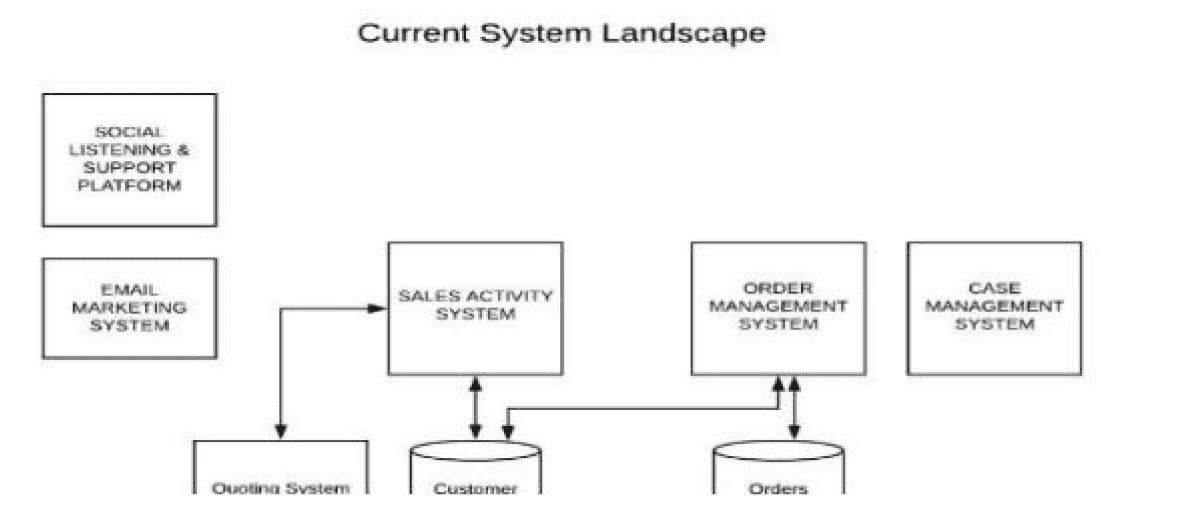
The goals for implementing Salesforce include:
Develop a 360-degree view of the customer.
Leverage Salesforce capabilities for marketing, sales, and service processes.
Reuse Enterprise capabilities built for quoting and order management processes.
Which three systems from the current system landscape can be retired with the
implementation of Salesforce?
A. Order Management, Case Management, and Email Marketing
B. Sales Activity, Order Management, and Case Management
C. Email Marketing, Sales Activity, and Case Management
Explanation:
The key to this question is matching the stated goals against which systems Salesforce natively replaces versus which systems must be reused and integrated with based on the explicit requirement.
The goals state:
Develop a 360-degree view of the customer
This is achieved by consolidating customer data into Salesforce.
Leverage Salesforce capabilities for marketing, sales, and service processes
This directly signals that Salesforce, through Marketing Cloud or Pardot capabilities, Sales Cloud, and Service Cloud, will replace the systems handling marketing, sales, and service or case functions.
Reuse enterprise capabilities built for quoting and order management processes
This explicitly states that the Quoting System and Order Management System should be kept and integrated with rather than replaced, because the company wants to leverage its existing enterprise investments in these capabilities.
Mapping this to the diagram:
Email Marketing System → replaced by Salesforce marketing capabilities → retire
Sales Activity System → replaced by Salesforce Sales Cloud → retire
Case Management System → replaced by Salesforce Service Cloud → retire
Social Listening & Support Platform → not explicitly called out in the goals; typically retained and integrated as a specialized tool rather than replaced by a core CRM function identified in the requirements.
Quoting System → explicitly called out to be reused, not retired
Order Management System → explicitly called out to be reused, not retired
Why not the others:
A. Order Management, Case Management, Email Marketing — Incorrect
Order Management is explicitly called out in the goals as a system whose capabilities should be reused and integrated, not retired.
B. Sales Activity, Order Management, Case Management — Incorrect
This has the same issue. Order Management should be retained according to the stated goal of reusing existing enterprise quoting and order management capabilities.
Key Exam Takeaway
When a scenario provides explicit business and architecture goals, map each system in the landscape diagram against those goals rather than assuming Salesforce will replace every existing system.
Here, the goals explicitly identify Quoting and Order Management as capabilities to integrate with and reuse, not decommission. This reflects a common enterprise architecture pattern in which Salesforce serves as the customer engagement and CRM layer while existing backend systems of record remain in place.
Reference
Salesforce Integration Patterns and Practices — Enterprise Architecture Considerations, including the CRM system-of-engagement model and integration with backend systems of record.
A customer is evaluating the Platform Events solution and would like help in comparing/contrasting it with Outbound Messaging for real-time/near-real time needs. They expect 3,000 customers to view messages in Salesforce. What should be evaluated and highlighted when deciding between the solutions?
A. In both Platform Events and Outbound Messaging, the event messages are retried by and delivered in sequence, and only once. Salesforce ensures there is no duplicate message delivery.
B. Message sequence is possible in Outbound Messaging, but not guaranteed with Platform Events. Both offer very high reliability. Fault handling and recovery are fully handled by Salesforce.
C. Both Platform Events and Outbound Messaging offer declarative means for asynchronous near-real time needs. They aren't best suited for real-time integrations
Explanation:
This question tests the architect's understanding of the appropriate use cases for Platform Events versus Outbound Messaging. Both are asynchronous, near-real-time mechanisms rather than true real-time integration tools.
Why this is the correct evaluation point
Declarative means:
Platform Events can be published declaratively through Flow or Process Builder, while Outbound Messages can be configured declaratively through Workflow Rules or Flow. Neither requires code for basic setup.
Asynchronous near-real-time:
Both mechanisms operate asynchronously. Outbound Messages are sent after a record is committed to the database, while Platform Events are published to an event bus for asynchronous delivery. Neither provides the synchronous, immediate response characteristic of a true real-time API call.
Not best suited for real-time:
True real-time integrations typically use synchronous request-response patterns, such as REST API callouts that provide an immediate response. Platform Events and Outbound Messages are inherently asynchronous, making them suitable for near-real-time scenarios where a small delay, such as seconds or minutes, is acceptable.
Fan-out consideration with 3,000 customers
The scenario mentions 3,000 customers viewing messages in Salesforce. This is an important architectural consideration.
Platform Events have limits on concurrent subscribers. If 3,000 customers each open a CometD subscription to view messages, the organization could exceed the applicable concurrent subscriber limit, causing subscription failures for additional users.
Outbound Messages are not designed for massive fan-out. They send SOAP messages to a configured endpoint URL for each message and are not intended to broadcast messages to thousands of individual users viewing a page.
Why Other Options Are Incorrect
A. In both Platform Events and Outbound Messaging, the event messages are retried by and delivered in sequence, and only once. Salesforce ensures there is no duplicate message delivery.
Incorrect. Neither mechanism guarantees in-sequence delivery or exactly-once delivery. Both can operate with at-least-once delivery semantics, meaning duplicate messages can occur. Outbound Messages may arrive out of sequence, and Platform Events do not provide a universal guarantee of ordering under all delivery conditions.
Therefore, an architecture must account for possible duplicate or out-of-order messages rather than assuming Salesforce guarantees exactly-once, ordered delivery.
B. Message sequence is possible in Outbound Messaging, but not guaranteed with Platform Events. Both offer very high reliability. Fault handling and recovery are fully handled by Salesforce.
Incorrect. Message sequence is not guaranteed in Outbound Messaging either, because retries can result in messages being delivered in a different order. In addition, fault handling and recovery are not completely handled by Salesforce for either mechanism.
Platform Events may require appropriate subscriber-side recovery mechanisms, while Outbound Messages retry delivery for a limited period and can eventually discard a message if the endpoint remains unavailable.
Key Exam Takeaway
Platform Events and Outbound Messaging are asynchronous mechanisms suited to near-real-time integration scenarios. They should not be treated as synchronous real-time APIs or as mechanisms that guarantee exactly-once, ordered delivery.
For architecture questions, also consider subscriber limits, fan-out requirements, retry behavior, ordering, and recovery responsibilities when selecting between Salesforce integration mechanisms.
| Page 1 out of 13 Pages |
| 1234 |
Our new timed 2026 Salesforce-Platform-Integration-Architect practice test mirrors the exact format, number of questions, and time limit of the official exam.
The #1 challenge isn't just knowing the material; it's managing the clock. Our new simulation builds your speed and stamina.
You've studied the concepts. You've learned the material. But are you truly prepared for the pressure of the real Salesforce Certified Platform Integration Architect (SP25) exam?
We've launched a brand-new, timed Salesforce-Platform-Integration-Architect practice exam that perfectly mirrors the official exam:
✅ Same Number of Questions
✅ Same Time Limit
✅ Same Exam Feel
✅ Unique Exam Every Time
This isn't just another Salesforce-Platform-Integration-Architect practice questions bank. It's your ultimate preparation engine.
Enroll now and gain the unbeatable advantage of:
| Exam Topic | With Our Test | Without Test | Critical Insight |
|---|---|---|---|
| API Design (REST/SOAP/OData) | 90% Mastery | 45% Mastery | Non-users struggle with payload optimization |
| Middleware (MuleSoft, Boomi) | 88% Accuracy | 42% Accuracy | Connector limitations are a top trap |
| Error Handling & Retry Logic | 85% Proficiency | 38% Proficiency | Exponential backoff is frequently tested |
| Security (OAuth, JWT, TLS) | 86% Retention | 35% Retention | Certificate pinning is a must-know |
| Event-Driven Architecture | 84% Clarity | 40% Clarity | Platform Events vs. CDC confuses self-study |

Copyright © - All Rights Reserved