Question 1
Choose 1
Refer to the exhibits.
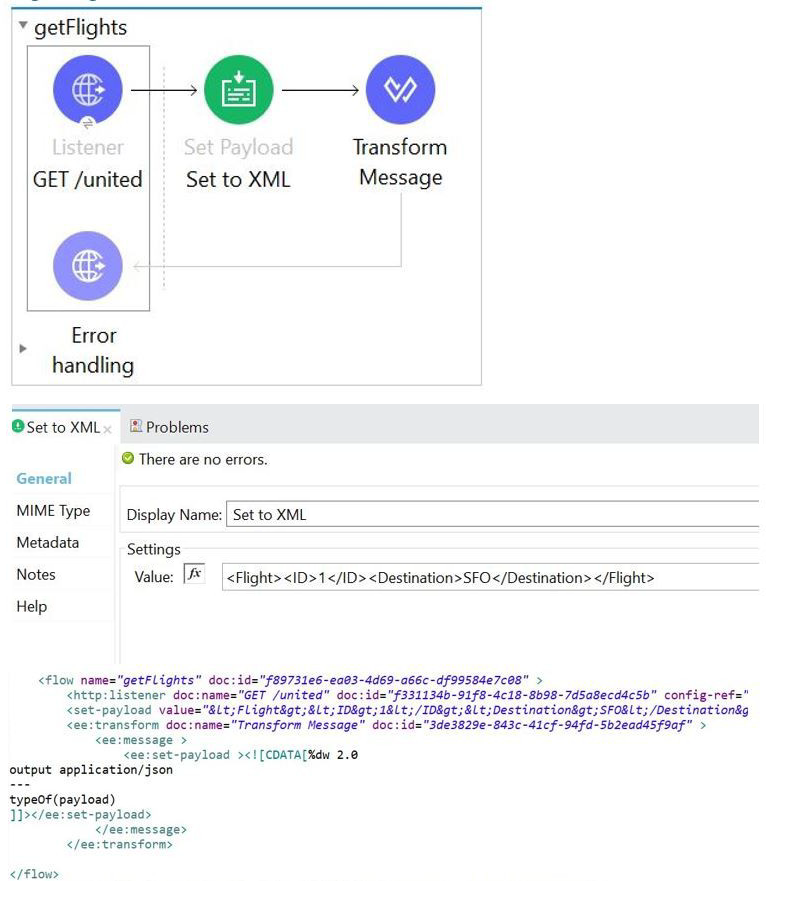
A web client submits a request to below flow. What is the output at the end of the flow?
Correct answer:
A. String
Explanation:
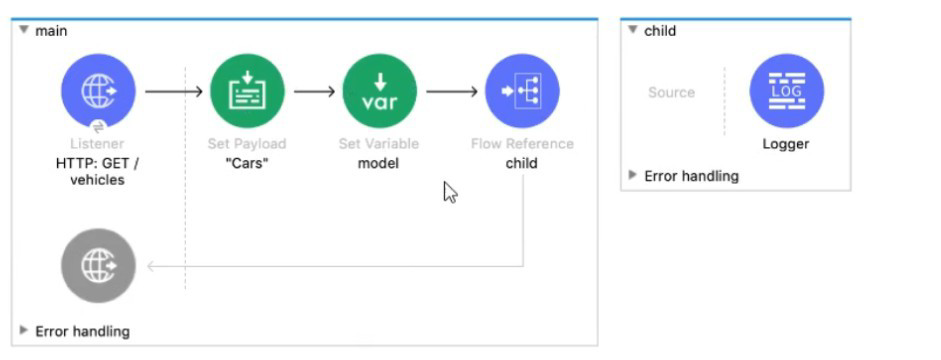
The flow consists of three main components: a Listener, a Set Payload component, and a Transform Message component.
Listener (GET /united): This component receives the inbound request, but its effect on the payload is minimal in this context. The payload starts empty (null) or based on the inbound request, but the next component immediately overwrites it.
Set Payload (Set to XML): This component sets the payload to a specific XML string value.
Value:1 SFO
MIME Type: Not explicitly shown, but typically a literal string or XML structure, resulting in a payload of type String (containing the XML content).
Transform Message: This component is the final operation that determines the output data type. The DataWeave script inside the Transform Message is the key:
$$
output application/json
---
typeOf(payload)
Output Directive: The output application/json directive indicates that the final output format of the Transform Message component will be JSON.
DataWeave Body: The body of the script is typeOf(payload). The typeOf() function in DataWeave returns a String representation of the data type of the payload it is inspecting. Since the payload entering the Transform Message is the XML String from the Set Payload component, typeOf(payload) will return the String value "java.lang.String".
Final Output: Although the output is formatted as JSON, the value being outputted is the String literal "java.lang.String". Since DataWeave's output directive converts the output value to the specified MIME type, a simple string output often results in a JSON string, which is still fundamentally a String representation when viewed in the context of the overall output data type. However, more fundamentally, the result of the DataWeave expression itself is a String (the string name of the type), and this is the direct output. Therefore, the output at the end of the flow is a String.
The most precise answer is String, as it's the result of the typeOf() function.
❌ Incorrect Answers
B. Object: The final output is the result of the typeOf() function, which is a String, not a complex Java object (Object).
C. Java: While the data type names in Mule are based on Java types (e.g., java.lang.String), the final output of the flow is the value returned by the DataWeave script, which is a String, not an arbitrary "Java" type.
D. XML: The payload enters the Transform Message as XML content (contained within a string), but the output is set to application/json, and the value generated by the script (typeOf(payload)) is a String literal, not XML.
📚 References
For detailed information on the components used: DataWeave typeOf() function: Refer to the MuleSoft documentation on DataWeave functions, which confirms that typeOf() returns a string with the name of the type.
Mule Flow Execution: Refer to the documentation on how the payload is passed between components and how the final component (Transform Message) dictates the final output structure and type.
The flow consists of three main components: a Listener, a Set Payload component, and a Transform Message component.
Listener (GET /united): This component receives the inbound request, but its effect on the payload is minimal in this context. The payload starts empty (null) or based on the inbound request, but the next component immediately overwrites it.
Set Payload (Set to XML): This component sets the payload to a specific XML string value.
Value:
MIME Type: Not explicitly shown, but typically a literal string or XML structure, resulting in a payload of type String (containing the XML content).
Transform Message: This component is the final operation that determines the output data type. The DataWeave script inside the Transform Message is the key:
$$
output application/json
---
typeOf(payload)
Output Directive: The output application/json directive indicates that the final output format of the Transform Message component will be JSON.
DataWeave Body: The body of the script is typeOf(payload). The typeOf() function in DataWeave returns a String representation of the data type of the payload it is inspecting. Since the payload entering the Transform Message is the XML String from the Set Payload component, typeOf(payload) will return the String value "java.lang.String".
Final Output: Although the output is formatted as JSON, the value being outputted is the String literal "java.lang.String". Since DataWeave's output directive converts the output value to the specified MIME type, a simple string output often results in a JSON string, which is still fundamentally a String representation when viewed in the context of the overall output data type. However, more fundamentally, the result of the DataWeave expression itself is a String (the string name of the type), and this is the direct output. Therefore, the output at the end of the flow is a String.
The most precise answer is String, as it's the result of the typeOf() function.
❌ Incorrect Answers
B. Object: The final output is the result of the typeOf() function, which is a String, not a complex Java object (Object).
C. Java: While the data type names in Mule are based on Java types (e.g., java.lang.String), the final output of the flow is the value returned by the DataWeave script, which is a String, not an arbitrary "Java" type.
D. XML: The payload enters the Transform Message as XML content (contained within a string), but the output is set to application/json, and the value generated by the script (typeOf(payload)) is a String literal, not XML.
📚 References
For detailed information on the components used: DataWeave typeOf() function: Refer to the MuleSoft documentation on DataWeave functions, which confirms that typeOf() returns a string with the name of the type.
Mule Flow Execution: Refer to the documentation on how the payload is passed between components and how the final component (Transform Message) dictates the final output structure and type.